Thursday, July 18, 2013

Podcasts for curious minds

In the latest issue of its eNewsletter sent to the Society the Royal Australian Historical Society has made this announcement which may be of interest to members. There are presently four podcasts listed on the site.

The RAHS is creating podcasts (audio broadcasts) of selected, lectures and seminars presented by authors, historians and researchers at the forefront of their fields making them accessible to the general public. These engaging sessions offer an eclectic mix on a wide variety of topics in Australian history and current historical issues in local history and heritage. If you missed Dr Louise Trott's fascinating talk discussing the role of the Sydney Diocesan Archives, which is a private, ‘in-house’, business, and academic research archive, giving special attention to some of the key documents in the collection you can listen to it here.

Tuesday, July 16, 2013

Writing Ku-ring-gai History Winners

Bridget's winning poster

It was a full house on Monday night, with excited children and proud parents at the awards night of the Ku-ring-gai Historical Society writing competition. 

Ku-ring-gai Mayor, Elaine Malicki acknowledged the high standard of entries as she presented the winners with their cheques.

The Years 3-4 students submitted posters depicting Ku-ring-gai Then and Now. 

The joint winners were:
Madeleine McDonell of Abbotsleigh and 
Bridget Lennon of Gordon East Public School. 

Sophie Manning of Masada College and 
Mia Clayton of Pymble Ladies College were the runners up.
Madeleine's winning poster
Years 5-6 students wrote an essay on an important historical person and the winner was: 
Lukas Hallett of Wahroonga Public School with his essay on Vernon Hordon Lumby (1933-2012).
Runners up were: 
Romi Grauman of Masada College and 
Penelope Lovell of Wahroonga Public School.

Years 7-9 students wrote about a location of historical importance and the winner was: 
Kate Soonius of Pymble Ladies College with Ku-ring-gai's Unique Blue Gum High Forest. 
Eloise Hanna of Pymble Ladies College the runner up.

The adult section was won by Sandra McGregor of Mt Ku-ring-gai with Echoes of Time and Place throughout Ku-ring-gai, 
and runner up was Evelyn Wyatt of Turramurra.

All entrants will receive a certificate, and a commemorative book published by the Society containing many of the entries.

You can see more of our winners and their entries on our website.

The copyright to all posters and essays has been vested in KHS © 2013. All rights reserved so if you would like to reproduce or use any of the posters or essays, please contact us (higher resolution copies are available). 

The Ones that got away

The Guest Speaker for our next General Meeting on July 20 at 2:00pm is COSHA Vice-President Murray Radcliffe with the topic The ones that got away:Some early  attempts by convicts to escape from Sydney Cove were doomed, while others were well-planned, ingenious and successful.

Visitors are most welcome to join us for the meeting at The Gordon Library Meeting Room, 799 Pacific Highway, Gordon. Afternoon Tea will be available.


Sunday, July 14, 2013

Writing Competition Presentation Night

As part of our 50th anniversary celebrations, we have run a writing competition.
Well, several competitions really. We had a number of categories for different age groups, from a Then and Now poster competition for Years 3-4, to essay competitions in age groups up to adult.

The standard of entries was great and we have produced a book containing the finalists' entries.
This book will be presented to the winners on the night along with their cheques.

Tomorrow night (Monday 15 July) is the presentation night.
Please come along and celebrate with us and the winners.
It is being held in the Gordon Library Meeting Room, 799 Pacific Highway, Gordon from 7.30pm.


Tuesday, July 9, 2013

How attitudes have changed


Reprint of an article by Max Farley originally published in Vol. 29 No. 7 August 2011 of the KHS Monthly Newsletter 

“Once families dreaded exposure of their convict connections. Today the discovery that a convict belongs in the family tree is a matter for celebration. ”

Most would today agree with these words expressed in Babette Smith’s recently published “Australia’s Birthstain – a Startling Legacy of the Convict Era”. For over 100 years, however, the existence of convict ancestors within families was kept a secret by later generations. So much so
that in many cases family members were not even aware of their convict’s existence themselves.
By the time the colony was 50 or so years old it was peopled in large numbers by emancipists who had served their time, by many Australian-born who had reached adulthood, as well as settlers who had come and prospered.

They all regarded themselves as “free”. Though crime, corruption, loose moral standards,  gambling, profanity, drunkenness and violence existed in large measure, Babette Smith puts it that there was growing pride in what was being achieved in the new country. People were accepted for
what they were and not for what they or their parents had earlier been. Opportunities for advancement existed which were not available for them in their homeland. Ideas of introducing democratic institutions in the colony were being discussed, with WC Wentworth in the forefront.
Why did having a convict ancestor later come to be a guilty secret?

At the risk of oversimplifying her views, Babette Smith puts forward the theory that three main groups in the “Mother Country” saw their interests as likely to be best served by emphasising the sinfulness existing in New South Wales and ignoring the positive aspects. These were:-
• those who had opposed transportation in the first place and wanted it stopped in favour of penal reform being developed in Britain itself;
• the clergy, too, opposed transportation., although their mission was to reform sinners and it was important that the wickedness of the colony be recognised and, with it, the need for their services, which also offered opportunities to spread church influence; and
• fine-intentioned people whose liberal inclinations applauded the abolition of slavery in America and who saw a similarity with the transportation of convicts to Australia.

For the most part they, as individuals, were totally ignorant of the true position in New South Wales. A 27-year old, Sir William Molesworth, became Chairman of the Transportation
Committee of the House of Commons. A Report of that Committee was destined to cause great damage to the status of the young colony.

These groups may not have been alone in spreading the belief that sin was rife in the colony, but they spread it with success. As an example, the Reverend Thomas Arnold, principal of the Rugby School, is quoted by Babette Smith as saying in c1834 “that the stain should last, not only for
one whole life but for more than one generation… that no convict child should ever be a free citizen: and that even in the third generation, the offspring should be excluded from all offices of honour or authority in the colony.”

The Molesworth Transportation Committee Report, released in 1838, painted an unhappy picture of the colony’s moral state. Though seen within five years as a failure, the inhabitants were taken aback by the Report because they had been expecting praise for the progress they had achieved.
Not only was their pride hurt, but there was alarm at the political and economic damage to the colony’s reputation. Not surprisingly, the Report was widely condemned by many
who had practical knowledge of the actual conditions. However, the bad publicity given it in England was lasting and widespread. Babette Smith believes Molesworth’s “version of the convict stain” was to infect the colonists themselves. The seeds of shame had been sown.

For many years afterwards there was a conspiracy of silence, both in government and private circles, to keep convict ancestry a secret. Babette Smith points out that, even as late as the 1950s, hundreds of priceless photographs of convicts were destroyed when the old Fremantle Gaol was
being renovated. Even more indicative of secrecy was the controversy that arose, as recently as 1980, when the 1828 Census was privately published by Johnson and Sainty of the Library of Australian History. Amongst other things it disclosed which people living in 1828 had come as convicts.

The 1980 publication angered some people who saw it as a threat to their ancestors’ reputations. However, “more enlightened academics” took a different view, and information about our pioneers, convicts and otherwise, is happily now freely available. The outdated sensitivities have now been discarded to the dustbin and many older Australians have come to be delighted to find they have a dinky-di convict amongst their ancestors. It may not be stretching the imagination to suggest
that Australia over recent decades has recaptured the pride so unsympathetically beaten out of it 160 and more years ago.

(Babette Smith was Guest Speaker at our Family History meeting 6 November 2010.)
Max Farley

Thursday, July 4, 2013

Built Heritage - Redleaf Chambers

Thanks to Society member, Kathie Rieth, for granting permission to publish some of the articles she has written for the Society newsletter. Her work on researching buildings in our local area should reach a new audience via this blog. Redleaf Chambers which appeared in the July 2010 newsletter is the subject of our first shared article

Redleaf Chambers
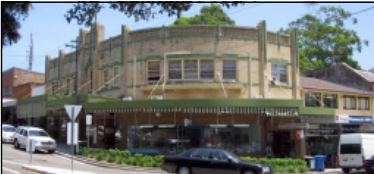
Redleaf Chambers sits at the junction of Railway and Redleaf Avenues, Wahroonga where the roundabout channels traffic through the shopping village and across the railway line. With its curved façade, ornate brickwork, greenglazed brick trims and smart green and cream striped sunblinds, it is a landmark for all Wahroonga residents.

I really like this building, and am pleased it has survived. It has real style - it has pizzaz! I wonder about the man who commissioned it and what the locals thought when it was built. Did they hate it or love it? And what do people think of it now? Surprisingly Redleaf Chambers is not listed on Council’s LEP. It certainly has architectural and municipal significance, two parameters for which buildings are usually nominated.

It was designed in 1937 for local estate agent Malcolm McFadyen by Frank l’Anson Bloomfield, architect for the first crematorium to be built in NSW (Rookwood), and Northern Suburbs Crematorium, and winner with Spencer of the 1950 Sulman Prize for the Top Dog Factory,
Brookvale.

McFadyen (1860-1949) was prominent in Wahroonga’s business community and served a number of terms on Council. He lived and worked in Wahroonga from about 1905 when he took over the newsagency in Coonanbarra Road. Within three years he had become a house and land agent, his ads stating “save time by consulting the local man”, and by 1911 had moved to premises in Railway Avenue.

He was a Ku-ring-gai councillor 1911-1913, 1917-1925 and elected Deputy President for 1922 and 1925. In May 1921, along with WS Griffiths and JG Lockley, he was appointed to an advisory town planning committee that examined subdivision plans, regulated setbacks and the like. In 1929, McFadyen strongly opposed the erection of flats in the municipality, stating “The flat dweller belongs to the floating population of the big cities and is of no value to the community”. It seems McFadyen modified his view, because when Redleaf Chambers was completed it was described as “five lock-up shops and flats”. Valued at £5500 it was a substantial and ambitious project for the then-small  shopping centre.

In January 1938 he was advertising for tenants - “Wahroonga, Redleaf Chambers, overlooking the Park, at station, 3 professional rooms, moderate rental to right person.” No mention of flats. Perhaps for a short time people lived there, perhaps McFadyen himself, though by 1943 he was living in 12 Bundarra Avenue with his wife Maggie and elder daughter Sylvia. Eventually the McFadyens moved to Queensland, where their two sons, Roy and Kenneth, and married daughter Millicent had lived for some time.

Monday, July 1, 2013

Family History Meeting - July

Our next Family History Group Meeting will be held in the Gordon Library Meeting Rooms on Saturday 6th July. The program for the day's activities follows:

11.00 am      New Zealand resources on the intranet and internet. Pauline Weeks will be in attendance.
 2.00 pm      General Meeting followed by a Members' Forum My latest successful or unsuccessful research

Visitors are welcome to join us for the meeting and afternoon tea.